
Translational Research – translating research into patient care strategies

“The answer is 17 years, what is the question: understanding time lags in translational research” – Morris, et al, 2011 (1)

It takes far too long for research findings to be ‘translated’ into health messages or techniques that reach the patient in need of health care guidance – 17 years on average according to the review of research study by Morris et al (2011). The team’s conclusion is that translational research is in need of further study but with more well defined terms and types of measurements so research by different teams can be compared. Twenty three studies were reviewed but the research parameters were diverse and not readily comparable. (1)

As a person with training and experience as a health care professional I followed general recommendations for general health and weight loss for many years but they didn’t help and I kept getting more sick with problems that didn’t show up on lab tests. Being told regularly that my symptoms must therefore be psychosomatic (mentally based) and that I should see a talk therapist did lead me to spending time with talk therapists and it helped somewhat but I kept getting more sick.

I knew I was physically sick, not just mentally making myself sick from stress or anxiety because I wasn’t always stressed or anxious and had always had some minor but chronic health problems as a child. So I eventually gave up on the standard not-helping-much answers and instead paid closer attention to my daily routine and dietary choices and slowly stopped doing any of the things that seemed to make me feel worse the next day. With the pay attention method I got somewhat better. Fibromyalgia and chronic fatigue symptoms were improved. Iodine supplements helped me with weight loss and a low dose antibiotic protocol developed for an autoimmune type of condition helped relieve my severe migraine problem.

Prescriptions can be quick and easy answers but they don’t always work, sometimes makes things worse, can delay trying other strategies that might work better – and can be expensive in insurance co-pays or be an out of pocket self pay expense. Health needs adequate sleep, with black out curtains and no lights, not even a digital alarm clock – keep it in a bedside table drawer or cover it with a towel. Even a little light at night can interfere with our production of melatonin and it helps with a variety of health needs throughout the body.

Health requires regular stretching and exercise that works out the heart and lungs and builds the other muscles somewhat. To maintain bone density requires weight bearing exercise – lifting weights in a warehouse or digging in a garden or in a gymnasium. Having the freedom to read text documents on your laptop while standing and using hand weights can multitask physical fitness needs with work or school needs. Varying positions and going for short walks occasionally is healthier than any type of job that requires too much of the same motions or having to stay in the same position for long periods of time.

Standing desks that can easily transition to a sitting desk can be as simple as a couple boxes under your laptop. Standing can allow some leg and arm stretches and then the boxes can be removed for some time spent sitting to type more intensively. Eight full hours in either position might be more of a health risk than being able to switch between the two options. (2)

Health requires all of the nutrients and additional fiber and antioxidants and other phytonutrients that aren’t considered essential in the same way vitamins are but may be necessary for more optimal health.

If it is reasonable to want to prevent measles or chickenpox, or other infectious diseases, then it seems reasonable to want to prevent age related degenerative disease by providing the body more of what it needs to remove toxins and rebuild tissue as it wears out. Even brain cells are replaced with new ones  – our entire body is not the same body that we had as a newborn. We are regularly removing old cells and growing new ones.

All truths are easy to understand once they are discovered. The point is to discover them. ~ Galileo

And the point of translational research is to improve the process of translating research findings into effective strategies for patient care. If research is still in early stages it may not be safe for all patients, finding out how to identify which patients it might help would then be a necessary step before translating the findings into patient education messages or health care protocols. How to guides ideally will always include safety warnings about which patients the health messages might harm if they were to use or be ineffective for their use.

As an individual it is good to know your rights as a patient and to seek health care professionals that take the time to listen. As a patient seeking a second opinion may be helpful and it can be helpful to write down your symptoms and mood changes, your daily diet or sleep habits, and any other routine habits in order to look back occasionally to see if any patterns show up in what is helping or not helping you feel better. We all need to remember that we are the ones living our lives and that makes us the ones in charge of taking care of our own health as best as we can.

It can take three weeks or more to build a habit and that suggests the reverse is likely true – and keeping a written tally sheet about the habit you want to change can help stay on track and help show where you may be veering off track. For more guidance, see Changing Habits, The Learning Center, University of North Carolina. (3)

Your Health Insurance agent is not your mother (probably), and in the current system large bills can lead to more profit for health insurance companies – so watch out for your  own budget by taking care of exercise, diet, and sleep habits and send your Health Insurance agent a nice card at the holidays instead of having them on speed dial for questions about your enormous co-pays. Insurance is nice but 10 or 20% of an enormous bill is still more than most of us have in the bank or can easily borrow. (4)

Bankruptcy due to health care costs has become too common – stay out of bankruptcy court by spending more time on daily health care habits – the research is fairly conclusive regarding the basics –

  • ideally at least 30-60 minutes of exercise 3-5 times per week,
  • drink plenty of water for thirst
  • and eat 5-9 servings of vegetables/whole fruit per day, get adequate protein, whole grains and essential omega 3 fatty acids without too much saturated and trans fats each day. Trying to include a serving of fatty fish three times per week can be a source of omega 3 fatty acids or vegetarian sources include walnuts, hemp seed kernels or ground flax seeds. Including a serving of beans, nuts and seeds on most days may increase the amount of magnesium and other important trace nutrients in the daily/weekly diet.
  • Six hours of sleep seems to be a minimum need for most people and more than eight hours on a regular basis may be too much or a sign of health or depression problems in adults once they are out of the teen years, (teens may benefit from ten hours of sleep per day, (6)). Short naps during the day can be a healthful activity and may increase work productivity, 20-30 minutes may be ideal. Longer naps may lead to waking up groggy instead of refreshed. (5)
  • Social activity and other relaxing hobbies also seem to be helpful for health.

/Disclaimer: This information is provided for educational purposes within the guidelines of fair use. While I am a Registered Dietitian this information is not intended to provide individual health guidance. Please see a health professional for individual health care purposes. Thanks./

  1. Zoë Slote Morris, Steven Wooding, and Jonathan Grant,

    The answer is 17 years, what is the question: understanding time lags in translational research., J R Soc Med. 2011 Dec; 104(12): 510–520. https://www.ncbi.nlm.nih.gov/pmc/articles/PMC3241518/

  2. Robert H. Shmerling, MD, The Truth Behind Standing Desks, Sept. 23, 2016, Harvard Health Blog, Harvard Health Publishing, health.harvard.edu,  https://www.health.harvard.edu/blog/the-truth-behind-standing-desks-2016092310264?utm_campaign=shareaholic&utm_medium=twitter&utm_source=socialnetwork
  3. Changing Habits, The Learning Center, University of North Carolina, https://learningcenter.unc.edu/tips-and-tools/changing-habits/
  4. Why Your Health Insurer Doesn’t Care About Your Big Bills, propublica.org, https://www.propublica.org/article/why-your-health-insurer-does-not-care-about-your-big-bills
  5. Napping, sleepfoundation.org, https://sleepfoundation.org/sleep-topics/napping
  6. See Chapter Two: The Lost Hour, Po Bronson and Ashley Merryman, NurtureShock: New Thinking About Children, Twelve, Hatchette Book Group, New York, 2009 http://www.nurtureshock.com/

Additional references for more information on translational medicine:

Excerpt from a post about my own genetic screening (Genetic Screening can give guidance about potential medication adverse reactions, 2018):

Additional reference for further discussion of the advances in the use of genetic screenings for medication risk is available in a book that is already slightly dated with the rapid advances in technology but as a starting point it is helpful for an overview on the history of technological advances in the area of medical care: The Creative Destruction of Medicine: How the Digital Revolution will Create Better Health Care, by Eric Topol, M.D., 2013. Basic Books. ISBN: 978-0465061839. (1) (“Book Review…,” and summary, by Jung A Kim, RN, PhD, PubMed_2)

One of the pioneers in personal genetic screening was Esther Dyson, a venture capitalist. She quoted a colleague regarding why she agreed to be one of the first ten participants in the Personal Genome Project:

“You would no more take a drug without knowing the relevant data from your genome than you would get a blood transfusion without knowing your blood type.” [128] (1)

The future of individualized health care will include genetic screening for everyone and what isn’t addressed in the book by cardiologist and translational research specialist Eric Topol, M.D. is the use of genetic screening for individualized nutrition guidance. In addition to discovering what medications may work better or be more dangerous for an individual genetic screening can target which types of exercise or diet plans may be more or less beneficial and which nutrients may need to be restricted or supplemented more than the average guidance.

My previous genetic screening was for fewer genes but which were chosen as most commonly a problem for children on the autism spectrum – I had 11 of the 30 and the guidance led to supplements and diet changes that have helped me feel better and have better mood stability – Methylation Cycle Defects – in me, Genetic Screening “For Research Purposes Only” – at this stage “For Research Purposes Only” is a legal phrase as genetic screening is not considered consistent enough for use as a diagnostic tool, but my personal health is of significant interest to me.

  1. Eric Topol, M.D,, The Creative Destruction of Medicine: How the Digital Revolution will Create Better Health Care, 2013. Basic Books. ISBN: 978-0465061839.  (1) Chapter 5, Biology: Sequencing the Genome, page 117: [128]
  2. Jung A Kim, RN, PhD, Book Review: The Creative Destruction of Medicine: How the Digital Revolution will Create Better Health CareHealth Inform Res. 2013 Sep; 19(3): 229–231.  https://www.ncbi.nlm.nih.gov/pmc/articles/PMC3810531/ PubMed_2)

[128] Esther Dyson, “Full Disclosure,” Wall Street Journal, July 25, 2007, A15.
Choline and betaine – water soluble nutrients

Choline is a newer discovery in the nutrient world. It is considered to be a member of the water soluble B vitamins group which are nutrients involved in metabolism – the use of energy within the body. We can produce small amounts of choline so it isn’t considered a vitamin but as we can not produce enough for health it is considered an essential nutrient. (1) Betaine is a slightly different form of choline. Choline is found throughout the body but is particularly important within the brain and is needed for the neurotransmitter acetylcholine. Betaine is a metabolite of choline.

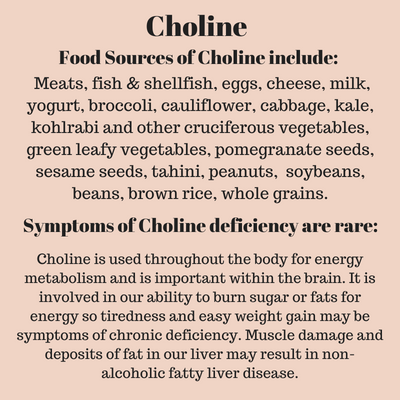
Choline, a water soluble nutrient. Foods Sources and symptoms of deficiency.

Choline is most typically found within phospholipids (such as phosphatidylcholine) which are important in membranes and as messenger chemicals within the brain and in the immune system. It may play a role in prenatal brain development but research on supplementation within pregnancy r to protect cognitive skills in the elderly is still in early stages. (1)

Choline is a  methyl donor (1) which means it can share a methyl group – essentially one carbon atom with three hydrogen atoms with an overall neutral charge.

An important role of methyl groups is in the release of energy from sugar within mitochondria. The methyl group is passed back and forth between nutrients and enzymes that are involved in breaking down a molecule of fat or sugar for use of the stored energy that is released when a double bond is broken. The methyl group is combined with an acetyl group when it is removed from the area on the chain of carbon molecules when a double bond is broken. An acetyl group is an atom of carbon combined with one atom of hydrogen and the group has a negative charge. The process for breaking down the glucose sugar molecule is called the Krebs cycle and most beginning level organic chemistry or nutrition students will remember having to memorize all of the steps involved. My summary may be inaccurate – college was a long time ago – the important point is that B vitamins and methyl donors are needed for mitochondria to be able to release energy from glucose/sugar molecules).

  • (The Krebs cycle is also known as the “citric acid cycle or the tricarboxylic acid (TCAcycle.” More info: Krebs cycle.)

Methyl groups are also important in controlling gene activity. They act like an on/off switch for genes. A gene that is fully methylated – all the available double bonds between carbon atoms are broken into single bonds with a methyl group added instead – is in the off position, the protein that the gene would encode is not being made. Genes that are unmethylated have double bonds and are in the on position, the pattern for assembling amino acids into a protein can be read by a matching strand of RNA and the protein can be formed (generally in the endoplasmic reticulum or Golgi apparatus areas of a cell).

Betaine and the more familiar B vitamins folate (B9 if anyone is counting), B6 and B12 are also methyl donors. Folate deficiency has been associated with less gene methylation (a histone is part of a gene). (2) More about methyl donors as a group is available here:  Methyl Donors and BPA.

  • The number system for naming B vitamins was derived at an earlier stage of research and some of the chemicals that were given numbers at the time were discovered to not be essential nutrients – meaning the body was able to form them within the normal health and didn’t essentially need to have them included in the diet (so that is why we don’t hear about a B4, B8, B10 or B11).

Excessive intake of choline above 7500 milligrams may cause a drop in blood pressure, sweating, vomiting and digestive upset, and change in body odor. The recommended Upper Limit is 3,500 mg/day. It would be difficult to reach that amount with food sources. (Safety information, lpi.oregonstate.edu)

Food Sources of Choline:

Good sources of choline include meats, fish & shellfish, eggs/egg yolks, cheese, milk, yogurt, broccoli, cauliflower, cabbage, kale, kohlrabi and other cruciferous vegetables, green leafy vegetables, pomegranate seeds, sesame seeds, tahini, peanuts,  soybeans, beans, brown rice, whole grains.

Food Sources of Betaine:

Sweet potatoes, meats, cheese, beets, basil, spinach, green leafy vegetables, brown rice, whole grains.

Disclaimer: Opinions are my own and the information is provided for educational purposes within the guidelines of fair use. While I am a Registered Dietitian this information is not intended to provide individual health guidance. Please see a health professional for individual health care purposes.

References:

  1. Choline, Linus Pauling Institute, Oregon State University, http://lpi.oregonstate.edu/mic/other-nutrients/choline
  2. Benjamin A. Garcia, Zigmund Luka, Lioudmila V. Loukachevitch, Natarajan V. Bhanu, Conrad Wagner, Folate deficiency affects histone methylation,

    Medical Hypotheses, Volume 88, March 2016, Pages 63-67, ScienceDirect, https://www.sciencedirect.com/science/article/pii/S0306987716000116

  3. Foods used in the 30% Calories from Carbohydrates Menu Plans, https://effectiveselfcare.info/2018/05/19/healthy-hair-is-the-proof-of-a-healing-diet/

Healthy Skin – visual sign of a healing diet

Strong, shiny hair that grows well and isn’t thinning can be a visual sign of good health inside the body too. Hair and fingernails are a slightly tougher form of skin and outer skin is a slightly tougher form of the membranes that line our internal organs and cells.

A more in depth analysis of the nutrient content in the Dairy, fish and meat version of the 30% of calories from carbohydrates example menu (the last one in the series) showed that adding herbs and spices does add nutrients to your day’s average intake, adding essential fatty acids and the green leafy ones include quite a bit of potassium which can help reduce the risk of hypertension. High blood pressure problems may be due to low potassium intake rather than just a problem of excess sodium. Nuts and seeds are also very nutritious.

The reanalysis led to a few slight changes in macronutrients as I went to a nutrient database that was more complete for a few ingredients (listed in the References below) so to make it close to 2000 again I reduced the portion of hemp kernels to one tablespoon.

Macro-nutrients: Total calories 2003 with approximately 129 grams of protein (516 calories, 25.8% ); 90 grams fat (810 calories, 40.4%): 147 grams digestible complex/simple carbohydrates (588 calories, 29.4%); and 47 grams of indigestible fiber.

(*The math percents don’t add up but in the nutrient databases the total calories do not always match the amount calculated from the grams – it is all somewhat estimated based on average types of foods and portions, so do pay attention to your own body’s hunger and fullness cues – and remember that thirst is best quenched with water. It is common to mistake thirst for hunger and to overeat and still not be satisfied because you needed a drink of water. In nature only breast milk and water are beverages that we were accustomed to having at different stages of life. Whole fruit and vegetables have fiber which slow down digestion of the fluid and sugars..)

The summary findings are vitamin D is very inadequate, only milk for drinking is notified so even with cheese and yogurt the amount is very low. Vitamin B 12 was also slightly low and potassium was helped by the spices but even with several vegetables the limited fruit left potassium (increasing the portion size of beans in place of meat increased the potassium a lot but decreased niacin and a couple minerals) and vitamin C slightly below goal. B vitamins are provided however and other minerals are within the U.S. Recommended Daily Intake goals. Calcium was over provided with the dairy servings plus calcium rich seeds and vegetables. I have three more plans to calculate, so we will see if B12 is more plentiful in any of the other examples.

*Macronutrients for the 30% carbohydrate with dairy and fish plan – 1993 calories with 127 grams Protein (508 calories, 25.5%/1993); 79 grams Fat (711 calories, 35.7%/1993); 145 grams digestible complex/simple Carbohydrate (580 calories, 29.1%/1993); and 73 grams indigestible Fiber.

** Macronutrients for the 30% carbohydrate with dairy plan – has walnuts and almonds instead – 1970 calories with 95 grams Protein (380 calories, 19.3%/1970); 91 grams Fat (819 calories, 41.6%/1970); 147 grams of digestible complex/simple Carbohydrate (588 calories, 29.8%/1970); and 78 grams indigestible Fiber.

*** Macronutrients for the 30% carbohydrate vegan plan – has 2 teaspoons of Nutritional Yeast Flakes added as a vegetarian source of B12, and 1/4 cup avocado, 1/2 cup tomato and large leaf of lettuce to make a sandwich or salad with it. I also added 1 teaspoon of cumin and coriander and 1/4 cup raw cilantro as I have been trying to eat those everyday. Cilantro may help the body with detoxification of heavy metals. – Calories 1964 with 84.9 grams protein, (340 calories, 17.3%/1964); 89.6 grams Fat (806 calories, 41%/1964); 148.8 grams digestible complex/simple Carbohydrate (595 calories, 30.3%/1964); and 93.3 grams indigestible Fiber.

*The list includes data for four meal plans now, within the same bullet point for easier comparison.

Micro-nutrients in milligrams (mg) unless otherwise listed:

Not all foods had information for all of the nutrients so this is an underestimate for some (Copper, Manganese, Selenium, Pantothenic Acid, Choline, Betaine, Vitamin D, E, K, Omega 3 and 6 Fatty Acids are some with incomplete data available).

  • 1615.03 mg Calcium /dairy & fish with beans & sweet potato instead of meat & fries – 1642.03/ //dairy & beans, with almonds, walnuts instead of fish – 1653.93// ///vegan plan- 1181.23/// I double checked the math. This is the with dairy meal plan and it is providing an excess amount of calcium. Goal: 1300 mg is recommended for teens of either gender, and 1000-1200 for older adults.
  • 23.72 mg Iron /with beans instead of meat… – 46.27/ //dairy & beans, with almonds, walnuts instead of fish – 44.96//  ///vegan plan-59.92 (hemp kernel portion size is larger in this plan, they are an exceptional source///- Goal: 8-11 for teen boys and men and menopausal women, 15-18 for teen girls and women.
  • 531.99 mg Magnesium /with beans instead of meat… – 750.99/ //dairy & beans, with almonds, walnuts instead of fish -777.79// ///vegan plan-856.07/// – Goal:  240-360 for boys, girls and women, 400-420 for men.
  • 2185.3 mg Phosphorus /with beans instead of meat… – 2467.8/ //dairy & beans, with almonds, walnuts instead of fish -2242.3// ///vegan plan-1993.5/// – Goal: 1250 for children and teens, 700 for adults.
  • 4385.47 mg Potassium /with beans instead of meat… – 5600.47/ //dairy & beans, with almonds, walnuts instead of fish -4791.97 (took out Dill Weed too, it helped here)// ///vegan plan-5341.67///- Goal: 4.5-4.7 grams 4500-4700 mg.
  • 1887.68 mg Sodium /with beans instead of meat… -1165.18/ //dairy & beans, with almonds, walnuts instead of fish -1183.28// ///vegan plan- 786.33 ( I add salt to taste at the table, whole vegan foods tend to be very low salt, this amount could be too low for health///- Goal: 1.2-1.5 grams, 1200-1500 mg.
  • 17.52 mg Zinc – /with beans instead of meat… –  15.74/ //dairy & beans, with almonds, walnuts instead of fish -15.69// ///vegan plan-14.736/// Goal: 8-9 mg for children, teen girls & women, 11 for teen boys & men.
  • 2.425 mg Copper – /with beans instead of meat… – 3.225/ //dairy & beans, with almonds, walnuts instead of fish -3.225// ///vegan plan-4.663 (Chia seeds portion is larger in this plan, it and other nuts, beans and avocado are a source, too much can be a problem, especially if there is too little zinc in the diet/// Goal: 700-900 micrograms (which would be 0.7-0.9 mg)
  • 3.81 mg Manganese -/with beans instead of meat… – 8.71/ //dairy & beans, with almonds, walnuts instead of fish -9.81// ///vegan plan-8.509/// Goal: 1.6-1.8 for girls and women, 1.9-2.3 for boys and men.
  • 308.125 micrograms Selenium -/with beans instead of meat… – 290.275/ //dairy & beans, with almonds, walnuts instead of fish -219.575// ///vegan plan-199.405/// Goal: 40-55 micrograms
  • 36.45 mg Fluoride -/with beans instead of meat… – 14.05/ //dairy & beans, with almonds, walnuts instead of fish -14.05// ///vegan plan-4.25/// Goal: 2-4 mg
  • 57.65 mg Vitamin C -/with beans instead of meat… – 51.25 (also without raw tomato)///dairy & beans, with almonds, walnuts instead of fish -49.65// ///vegan plan-80.97/// Goal: 45-75 mg for children 9-13 y, teens & women, 90 mg for men.
  • 2.048 mg Thiamin (B1) -/with beans instead of meat… – 2.285/ //dairy & beans, with almonds, walnuts instead of fish -2.022// ///vegan plan- 4.221 (the nutritional yeast flakes is exceptionally high in several B vitamins)/// Goal: 0.9-1.2 mg
  • 2.111 mg Riboflavin (B2) -/with beans instead of meat… – 2.312/ //dairy & beans, with almonds, walnuts instead of fish -1.903// ///vegan plan- 3.788/// Goal: 0.9-1.3 mg
  • 30.421 mg Niacin (B3) -/with beans instead of meat… – 24.421/ //dairy & beans, with almonds, walnuts instead of fish -9.984// ///vegan plan- 19.969/// Goal:  12-16 mg
  • 6.27 mg Pantothenic Acid (B5) -/with beans instead of meat… – 6.77/ //dairy & beans, with almonds, walnuts instead of fish -3.97// ///vegan plan- 4.12/// Goal: 4-5 mg
  • 2.73 mg Vitamin B6 -/with beans instead of meat… – 2.582/ //dairy & beans, with almonds, walnuts instead of fish -1.129//  ///vegan plan- 2.534/// Goal: 1.0-1.7 mg
  • 365.02 mg Folate -/with beans instead of meat… – 724.52/ //dairy & beans, with almonds, walnuts instead of fish -707.62// ///vegan plan-928.32 (the nutritional yeast)/// Goal: 300-400 mg
  • 8.54 micrograms vitamin B12 -/with beans instead of meat… – 6.02/ //dairy & beans, with almonds, walnuts instead of fish -1.32// ///vegan plan-2.9 /// Goal: 1.8 for children and teens, 2.4 for adults.
  • 153 mg Choline /with beans instead of meat… – 76.3/ //dairy & beans, with almonds, walnuts instead of fish -96.5// ///vegan plan- 78.5/// (newer discovery, in the family of water soluble B vitamins) – Goal: 375-400 mg for children and teen girls, 425 for women and 550 for teen boys and men.
  • 7.71 mg Betaine /with beans instead of meat… – 22.01 (the sweet potato was the great source)/ //dairy & beans, with almonds, walnuts instead of fish -22.16// ///vegan plan- 43.11/// (also in the family of water soluble B vitamins) – Goal: 20-25 for children, 9-13 y and teens, 30 for adults.
  • 154.1 Vitamin A in RAE /with beans instead of meat… – 598.1 (the sweet potato was the great source)/ //dairy & beans, with almonds, walnuts instead of fish -589.1// ///vegan plan- 1298.1/// (Retinal A Equivalents) -new & not all data is available
  • 18329.45 IU Vitamin A /with beans instead of meat… – 27233.9/ //dairy & beans, with almonds, walnuts instead of fish -26988.2// ///vegan plan-40913.2///  (IU – International Units, beta-carotene and retinal) – Goal: 600-900 micrograms, (extra beta-carotene from produce is nontoxic, excess retinal can be a danger especially to a developing fetus)
  • 6.4 IU Vitamin D /with beans instead of meat… – 3.4/ //dairy & beans, with almonds, walnuts instead of fish -3.4// ///vegan plan- 0/// (IU – International Units) *note only liquid milk for drinking is typically fortified with vitamin D, the yogurt and cheese is clearly not a good source. – Goal: 15-20 micrograms (the IU is confusing, I will have to brush up on what exactly is meant)
  • 11.49 mg Vitamin E – /with beans instead of meat… – 20.2 (increasing the portion size of hemp kernels made the difference here)/ //dairy & beans, with almonds, walnuts instead of fish -27.8// ///vegan plan- 30.456/// Goal: 11 mg for 9-13 year old children and 15 mg for teens and adults.
  • 128.11 micrograms Vitamin K -/with beans instead of meat… – 91.51 (there had been extra lettuce with the hamburger, salad is great have some!/ //dairy & beans, with almonds, walnuts instead of fish -91.91// ///vegan plan-152.66///  Goal: 60-75 for children 9-13 y, and teens, 90 for women, 120 for men.
  • 28.341 grams Saturated Fat /with beans instead of meat… – 23.891/ //dairy & beans, with almonds, walnuts instead of fish -24.483// ///vegan plan- 14.97///
  • 26.867 grams Mono-unsaturated Fat /with beans instead of meat… – 21.251/ //dairy & beans, with almonds, walnuts instead of fish -19.551// ///vegan plan- 20.89///
  • 25.931 grams Poly-unsaturated Fat /with beans instead of meat… – 26.9/ //dairy & beans, with almonds, walnuts instead of fish -34.9// ///vegan plan- 42.457///
  • 0.393 grams Trans-unsaturated Fat /with beans instead of meat… – 0/ //dairy & beans, with almonds, walnuts instead of fish -0// ///vegan plan- 0///
  • 257.5 milligrams Cholesterol /with beans instead of meat… – 186.5/ //dairy & beans, with almonds, walnuts instead of fish -77.5// ///vegan plan- 0///
  • 7005.43 milligrams Omega-3 Fatty Acids (Salmon and Chia Seeds were extremely good sources) – /with beans instead of meat… –  7251.33 (black beans are a good source)/ //dairy & beans, with almonds, walnuts instead of fish -4542.03 (walnuts are a good source but the salmon was a better source)// ///vegan plan- 6877.08/// Goal: 1.0 – 1.6 grams – which would be 1000 to 1600 milligrams – this recommendation is lower than some doses found beneficial in research, 6 grams/6000 milligrams has been used in depression studies. (23)
  • 13908.25 milligrams Omega-6 Fatty Acids (Brazil Nuts, Tahini, Hemp Kernels were extremely good sources, Salmon, Chia and Pomegranate Seeds were good sources.) – /with beans instead of meat… – 16490.25 (increasing portion size of hemp kernels was the main increase but beans are also a source)/ //dairy & beans, with almonds, walnuts instead of fish -24892.25//  ///vegan plan- 28920.45/// Goal: 10-12 grams for females, 12-17 for males – which would be 10000-17000 milligrams,
  • Disclaimer: Opinions are my own and the information is provided for educational purposes within the guidelines of fair use. While I am a Registered Dietitian this information is not intended to provide individual health guidance. Please see a health professional for individual health care purposes.

References:

  1. Black Beans, cooked with salt, 1 cup (x.5) http://nutritiondata.self.com/facts/legumes-and-legume-products/4419/2
  2. Yogurt, plain, skim milk 13 gr protein per 1 cup (x .5)  http://nutritiondata.self.com/facts/dairy-and-egg-products/106/2
  3. Parmesan Cheese, shredded 1 Tbs (x 2) http://nutritiondata.self.com/facts/dairy-and-egg-products/134/2
  4. Ricotta Cheese, part skim 1 cup (x.25) http://nutritiondata.self.com/facts/dairy-and-egg-products/36/2
  5. Cheddar Cheese, 1 ounce, 28 grams http://nutritiondata.self.com/facts/dairy-and-egg-products/8/2
  6. USDA Food Composition Databases,  brazil nuts https://ndb.nal.usda.gov/ndb/foods/show/45157777?fgcd=&manu=&format=&count=&max=25&offset=&sort=default&order=asc&qlookup=brazil+nuts&ds=&qt=&qp=&qa=&qn=&q=&ing=
  7. Nut and Seed Products, Brazil Nuts (1 cup is 133 grams, I divided by 14.25 to get 1/3 of 28 grams) http://nutritiondata.self.com/facts/nut-and-seed-products/3091/2
  8. Finfish and shellfish products, Salmon, Alaska wild caught, 1/2 fillet 154 grams,   http://nutritiondata.self.com/facts/finfish-and-shellfish-products/4231/2
  9. Carrot, raw 1 cup, (x .5) http://nutritiondata.self.com/facts/vegetables-and-vegetable-products/2383/2
  10. Celery, raw, 110 gr, (x .5) http://nutritiondata.self.com/facts/vegetables-and-vegetable-products/2396/2
  11. Spice, Basil, dried leaves, 1 tablespoon, 2 gr   http://nutritiondata.self.com/facts/spices-and-herbs/173/2
  12. Oregano, dried, 1 teaspoon 1 gr http://nutritiondata.self.com/facts/spices-and-herbs/197/2
  13. Chives, freeze-dried, 1/4 cup, 1 gr ( x.25) http://nutritiondata.self.com/facts/vegetables-and-vegetable-products/2733/2
  14. Lundberg Organic Brown Rice Cake, Lightly Salted,  1 cake is 60 calories,  http://www.lundberg.com/product/organic-brown-rice-cake-lightly-salted/
  15. Rice long grain, brown cooked, 1 cup, 216 calories ( multiply x .56) http://nutritiondata.self.com/facts/cereal-grains-and-pasta/5707/2
  16. Tahini from roasted and hulled seeds, most common type, 1 tablespoon ( x 2) http://nutritiondata.self.com/facts/nut-and-seed-products/3142/2
  17. Chia Seeds, dried, 1 ounce (28 grams) (~ 2 Tbs) (x  .5)) http://nutritiondata.self.com/facts/nut-and-seed-products/3061/2
  18. Pomegranate, one 4 inch, (x .5 ~ 1/3-1/2 cup seeds) http://nutritiondata.self.com/facts/fruits-and-fruit-juices/2038/2
  19. Vegetable oil, coconut http://nutritiondata.self.com/facts/fats-and-oils/508/2
  20. Cocoa powder processed with alkali, Dutch, 1 cup, 86 gr (x .125) http://nutritiondata.self.com/facts/sweets/5472/2
  21. Tarragon, dried leaves, 1 tablespoon, 2 gr http://nutritiondata.self.com/facts/spices-and-herbs/210/2
  22. Hemp seed kernels, * complete protein source (Table 3) and good source of GLA omega 6 fatty acid  http://www.fao.org/fsnforum/sites/default/files/discussions/contributions/Hempseed_as_a_nutritional_resource-_An_overview_2.pdf
  23. Alan C. Logan, Omega-3 fatty acids and major depression: A primer for the mental health professional. Lipids Health Dis. 2004; 3: 25. https://www.ncbi.nlm.nih.gov/pmc/articles/PMC533861/
  24. Sweet Potato cooked, baked in skin without salt, 1 medium (60 gram) http://nutritiondata.self.com/facts/vegetables-and-vegetable-products/2667/2
  25. Walnuts, English, 1 ounce (28 gr) (x .5) http://nutritiondata.self.com/facts/nut-and-seed-products/3138/2
  26. Almonds, ( 1 ounce 23 whole kernels), http://nutritiondata.self.com/facts/nut-and-seed-products/3085/2
  27. Cumin Seed, ground spice, 1 Tbs (x .33) http://nutritiondata.self.com/facts/spices-and-herbs/184/2
  28. Coriander Seed, ground spice, 1 Tbs (x .33) http://nutritiondata.self.com/facts/spices-and-herbs/183/2
  29. Cilantro, raw, 1/4 cup http://nutritiondata.self.com/facts/vegetables-and-vegetable-products/2414/2
  30. Avocado, raw 1 ounce 28 gr (x 1.8), http://nutritiondata.self.com/facts/fruits-and-fruit-juices/1843/2
  31. Nutrient Recommendations: Dietary Reference Intake (DRI) Goals https://ods.od.nih.gov/Health_Information/Dietary_Reference_Intakes.aspx
  32. Hamburger, 95% lean, 5% fat, pan  broiled, 100 gr (~ 4 oz) http://nutritiondata.self.com/facts/beef-products/6190/2

More 30% calories from carbohydrate diet plan examples

Adding salmon as a source of omega 3 fatty acids and a tablespoon of dried dill weed for flavor and additional phytonutrients, increased the ratio of protein and decreased the ratio of fat while maintaining the carbohydrate ratio. The walnuts were removed as a vegetarian source of omega 3 fatty acids and the almonds were removed to reduce total calories.

The calories totaled 2001, with 126.75 grams protein (507 calories, 25.3%/2001); 78.31 grams fat, (704.8 calories, 35%/2001); 148.66 grams digestible complex/simple carbohydrates, (594.6 calories, 29.7%/2001); 57.4 grams indigestible fiber.

30% carbohydrate diet plan example with low carbohydrate dairy and omega 3 rich fish; it includes approximately 2-3 low carbohydrate dairy equivalents (1 cup/1 ounce); 5 protein (1 ounce) meat/fish equivalents; 6-7 protein (1 ounce/ 1/2 cup beans) equivalents of the bean, nut, and seed group; 1 fruit group serving; 2 bread group servings; 6 vegetable group servings; 1 additional fat group serving (the nuts/seeds contain quite a bit of fat, the coconut oil is the additional fat serving):

See the food items and nutrient content here: (Excel 30% calories from CHO, with dairy & fish).

  • CHO is a chemical reference to the molecular structure of carbohydrates which are a combination of atoms of – Carbon Hydrogen Oxygen.
Black beans, 2 cups
Greens, 2 cups
Fennel Seed 2 Tbs
Yogurt, plain, lowfat unswtnd (1/2 cup)
Parmesan Cheese, shredded, 2 Tbs
Ricotta Cheese, 1 cup
Cheddar Cheese, 28 gr/1 ounce
Brazil nuts, 2-3, 1/3 oz
Salmon, wild caught 5 ounces
Carrot, 1 med, 1/2 cup, 61 gr
Celery, 1 large, 1/2 cup, 61 gr
Basil, dried, 1 Tbs
Oregano, dried 1 tsp
Chives, dried 1 Tbsp
Lemon Juice, conc bttld 2 Tbs
Sweet Potato, plain 1/2 cup 55 gr
Lundberg Rice Cakes, 2
Tahini, 1 oz, 2 Tbs
Chia Seeds, 2 Tbs
Pomegranate seeds, raw 1/2 cup, 70 gr
Coconut oil, 1 teaspoon
Cocoa Powder, 2 Tbs
Tarragon, dried, 1 Tbs
Hemp kernels, 3 Tbs
Dill weed, dried, 1 Tbs

What if you don’t like beans? I would encourage you to start with a smaller amount per day, 1/2 cup serving remains in the following meal plan example to help get the digestive system adjusted to them. In place of the larger serving of beans and side dish of sweet potatoes is a hamburger and bun, 1/2 cup of French Fries, 1/2 a Dill Pickle, lettuce, tomato, 1 tablespoon of ketchup and a teaspoon of mustard – the dill pickle and mustard are essentially calorie free foods but they add significant amounts of salt so portion control is still a good idea. Cardamom spice is also added in, but simply because I forgot it in the earlier example of my own typical diet plan.

The new example totals 2004 calories with 129.94 grams of protein (520 calories, 26%/2004); 90.17 grams fat (811.5 calories,  40.5%/2004); 143.99 grams of digestible complex/simple carbohydrate (576 calories, 28.7%/2004); 40.2 grams indigestible fiber.

It includes approximately 2-3 low carbohydrate dairy equivalents (1 cup/1 ounce); 9 protein (1 ounce) meat/fish equivalents; 3-4 protein (1 ounce/ 1/2 cup beans) equivalents of the bean, nut, and seed group; 1 fruit group serving; 3-4 bread group servings; 6 vegetable group servings; 1 additional fat group serving (the coconut oil).

See food items & nutrient content here: (Excel 30% calories from CHO with dairy, fish & meat)

Black beans, 1/2 cup
Greens, 2 cups
Fennel Seed 2 Tbs
Yogurt, plain, lowfat unswtnd (1/2 cup)
Parmesan Cheese, shredded, 2 Tbs
Ricotta Cheese, 1 cup
Cheddar Cheese, 28 gr/1 ounce
Brazil nuts, 2-3, 1/3 oz
Salmon, wild caught 5 ounces
Carrot, 1 med, 1/2 cup, 61 gr
Celery, 1 large, 1/2 cup, 61 gr
Basil, dried, 1 Tbs
Oregano, dried 1 tsp
Chives, dried 1 Tbsp
Lemon Juice, conc bttld 2 Tbs
Cardamom, spice, 1 tsp
Lundberg Rice Cakes, 2
Tahini, 1 oz, 2 Tbs
Chia Seeds, 1 Tbs
Pomegranate seeds, raw 1/2 cup, 70 gr
Coconut oil, 1 teaspoon
Cocoa Powder, 2 Tbs
Tarragon, dried, 1 Tbs
Hemp kernels, 3 Tbs
Dill weed, dried, 1 Tbs
Beef, grnd, 93% lean, 7% fat, 4 ounces
Hamburger Bun, enriched, one
French Fries, 84 grams (~ 1/2 cup)
Dill Pickle, Organic Kosher, 28 grams, 1/2 spear
Tomato, raw sliced, ~ 1/2 cup
Lettuce, 1 outer leaf, 24 grams

Ketchup, 17 grams ~ 1 tablespoon

Mustard, yellow, 5 grams, ~ 1 teaspoon

(the last two items simply didn’t copy/paste with the rest of the table.)

Disclaimer: Opinions are my own and the information is provided for educational purposes within the guidelines of fair use. While I am a Registered Dietitian this information is not intended to provide individual health guidance. Please see a health professional for individual health care purposes. Thanks.