
For those who can’t grow pomegranates, consider sumac instead

Sumac is a shrub like tree or a tree like shrub that is an invasive plant in many areas. Types that have white berry clusters should be avoided as the white berries are poisonous but the types with clusters of red berry like seeds are safe to consume when made into a tea and they may be dried and ground into a spice. Native Americans use them in a lemonade like beverage and they are ground into a spice which is used in many Middle Eastern dishes and as a table condiment to sprinkle on foods to individual taste. The ground Sumac is mixed with salt or available plain in shaker bottles and is mixed with a few other spices in the blend called za’atar (sesame seed, salt, and thyme or hyssop).

Some of the phytonutrient content and medicinal properties  of edible sumac are similar to those found in pomegranate and may be associated with the bright red pigmentation. The botanical name for Sumac , ‘Rhus,’ translated as a foreign word means ‘red.’ Some people may be allergic skin reactions from touching the plant in nature (1) and as a more concentrated tea it has diuretic properties, which can have health benefits to help remove toxins if plenty of additional water is also consumed to prevent dehydration. (2)

Sumac is used medicinally in Arab countries. Studies on sumac extracts to date have indicated that the plant may be a source of bioproducts with the following bioactivities: antifibrogenic, antifungal, anti-inflammatory, antimalarial, antimicrobial, antimutagenic, antioxidant, antithrombin, antitumorigenic, antiviral, cytotoxic, hypoglycaemic and leukopenic (Rayne and Mazza, 2007).” (1)

The lemonade like flavor would be from the terpene limonene and possibly other terpenes found in the plant. Anthocyanins likely give it some of the bright color. It also contains tannins primarily in the form of gallotannins, which are similar to the elligatannins/ellagic acid found in pomegranate, (3), and other aldehydes and beneficial acids that give it tartness including vitamin C – ascorbic acid. (1) Eating a large enough amount on a regular basis may be important for the health benefits from phytonutrients. Research with elligatannins has found them helpful for cancer prevention and somewhat for treatment (4) but a recent study that used a small dose, 900 mg of pomegranate extract per day, found some changes in important genes but not conclusive health benefits. (5) Research on tumor inhibiting properties of sumac found it beneficial during early stages when the tumor is developing rather than as a treatment after it was formed (animal study). (6) Animal based trials in more recent research that found benefits using pomegranate extract used doses that would be equivalent to larger doses, 1 to 10 grams/kilogram body weight per day. The study and amounts used are discussed in this post and the link is in this earlier post. A beneficial substance that we have to make for ourselves, Nrf2 may be involved. Tannins, anthocyanins, and aldehydes were all mentioned as being helpful for helping promote our own body’s ability to produce more Nrf2. The gallic acid (related chemically to the gallotannins, the mango fruit is also a source (8)) is mentioned to help induce apoptosis in cancer cells (cell death) in an article discussing the role of oxidative stress in cancer treatment. (7)

“Gallic acid (3,4,5-trihydroxybenzoic acid, GA), a polyhydroxy phenolic compound, is abundant in natural plants such as gallnut, grapes, sumac, oak bark, green tea apple peels, grapes, strawberries, pineapples, bananas, lemons, and in red and white wine. Its antioxidative DNA-damage action has been well documented []. However, gallic acid induces apoptosis in several cancer cell lines by increasing ROS level and GSH depletion [].” (7)

That excerpt is from a section titled: 5.1. Anticancer ROS-Generating Compounds from Natural Origin(7), which also contains information on other phytonutrients and foods that contain them that have been found beneficial for preventing or treating cancer or reducing oxidative stress.

I bought some dried sumac prepared for table use but chose a brand without salt added to it so I could use as much as I want without having to be concerned about adding too much salt. The aroma and flavor are good and the color is very pretty, slightly more purplish than paprika but similar in the bright addition it makes when sprinkled on the surface of a food. It was $3.99 for a 9.33 ounce bottle at a Middle Eastern foods grocery store.

Phytonutrients with bright colors often seem to be associated with health benefits but that doesn’t mean all wild berries or plants are edible. Read guides and know what you’re harvesting before eating it – and avoid private property and nature preserves where it might be illegal to pick anything.

They are so common in some areas that I happen to have picture taken on a recent walk. A discussion with more detail and a close up image taken during late summer is available here: The ‘Lemonade Tree’: It’s Time to Harvest Sumac, EdibleEastEnd.com. (2)
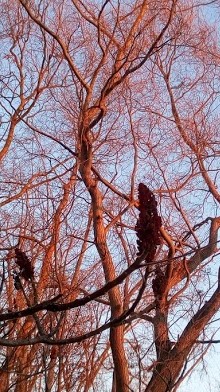
Wild sumac seed pod in wintertime.

Disclaimer: Opinions are my own and the information is provided for educational purposes within the guidelines of fair use. While I am a Registered Dietitian this information is not intended to provide individual health guidance. Please see a health professional for individual health care purposes.

  1. Sumac – an overview, ScienceDirect Topics, sciencedirect.com,   https://www.sciencedirect.com/topics/agricultural-and-biological-sciences/sumac
  2. Ronald Halweil, The ‘Lemonade Tree’: It’s Time to Harvest Sumac, Edible East End, August 9, 2012, EdibleEastEnd.com,   https://www.edibleeastend.com/2012/08/09/harvest-sumac/
  3. J. P. PerchelletH. U. GaliE. M. PerchelletP. E. LaksV. BottariR. W. Hemingway, and A. ScalbertAntitumor-Promoting Effects of Gallotannins, Ellagitannins, and Flavonoids in Mouse Skin In Vivo
    Food Phytochemicals for Cancer Prevention, Chapter 25, pp 303–327
    Chapter DOI: 10.1021/bk-1994-0546.ch025, ACS Symposium Series, Vol. 546, http://pubs.acs.org/doi/abs/10.1021/bk-1994-0546.ch025
  4. Tariq Ismail, Cinzia Calcabrini, Anna Rita Diaz, Carmela Fimognari, Eleonora Turrini, Elena Catanzaro, Saeed Akhtar, and Piero Sestili,

    Ellagitannins in Cancer Chemoprevention and Therapy. Toxins (Basel). 2016 May; 8(5): 151. https://www.ncbi.nlm.nih.gov/pmc/articles/PMC4885066/

  5. Nuñez-Sánchez MA, González-Sarrías A, García-Villalba R, et al, Gene expression changes in colon tissues from colorectal cancer patients following the intake of an ellagitannin-containing pomegranate extract: a randomized clinical trial. J Nutr Biochem. 2017 Apr;42:126-133. doi: 10.1016/j.jnutbio.2017.01.014. Epub 2017 Jan 27.    https://www.ncbi.nlm.nih.gov/pubmed/28183047
  6. Perchellet, J.P., Gali, H.U.Perchellet, E.M.Laks, P.E.et al., Antitumor-promoting effects of gallotannins, ellagitannins, and flavonoids in mouse skin in vivo  [1994], ACS symposium series, ISSN : 0097-6156, Source: Information Systems Division, National Agricultural Library, http://agris.fao.org/agris-search/search.do?recordID=US9602151

  7. Giuseppina Barrera, Oxidative Stress and Lipid Peroxidation Products in Cancer Progression and Therapy., ISRN Oncol. 2012; 2012: 137289.  
       https://www.ncbi.nlm.nih.gov/pmc/articles/PMC3483701/
  8. Gallotannins, Science Direct, ScienceDirect.com,   https://www.sciencedirect.com/topics/biochemistry-genetics-and-molecular-biology/gallotannins

Collectivist and Individualist Cultures and long term survival

If the mission is long term survival of the human species and as many other species as possible (because more biodiversity in an ecosystem has been shown to be linked with less harmful pathogens and disease), then it makes sense to take note that the Chinese civilization (a collectivist culture) has already survived as a nation for over 5000 years.

Having made that point I’ll let someone else add more detail: China vs. America; Managing the Next Clash of Civilizations, by Graham Allison, Aug. 15, 2017, Foreign Affairs, Sept/Oct 2017, available online: (https://www.foreignaffairs.com/articles/united-states/2017-08-15/china-vs-america)

And for background information a psychology wikia page on the topic is asking for specialist in the field of study to refine the page, but for getting started purposes it provides the basics: Collectivist and Individualist Cultureshttp://psychology.wikia.com/wiki/Collectivist_and_individualist_cultures

Trying to change lead into gold or apples into oranges is a waste of time – appreciating the value of differences and building on the strengths of each and recognizing the weaknesses of each might help us all (our great-great-great’s grandchildren) be speaking some language 5000 years from now instead of the planet returning to giant pool of sulfur loving bacteria. In evolutionary terms the sulfur loving bacteria ruled a very long time. They are theorized to be the first form of life to have survived the heat and low oxygen levels of the early volcanic time period of our planet’s history. (sulfur-loving bacteria/ page 16, 1000 Events that Shaped the World, National Geographic Society (U.S.))

Disclaimer: Opinions are my own and the information is provided for educational purposes within the guidelines of fair use. While I am a Registered Dietitian this information is not intended to provide individual health guidance. Please see a health professional for individual health care purposes.

Glyphosate from Roundup causing soil problems in No-Till agriculture

In a recent article published for the agricultural No-Till system specialists were recommended to reduce use of the GM crops that are designed to use the herbicide Round-Up which contains glyphosate by rotating non Round-Up crops with the GM Round-Up ready crops. Research findings suggest the chemical glyphosate is remaining in the soil longer than expected, over years of time, and collecting to levels that seem to support increased fungal pathogens. Some types of healthy strains of bacteria that would typically help protect the soil environment from the harmful strains of fungi are being negatively affected by the glyphosate. Some crops are also beginning to be affected by the increased saturation of glyphosate within the soil.

See “Glyphosate & GM Crops are Harming No-Till Soils,” GMwatch.org, Jan. 10, 2018, for more detail.

The fungi that may be promoted by increased concentrations of glyphosate may include Fusarium strains which can affect large percentages of a crop causing a large financial loss to the farmer. The effect has been noted in Canadian research: Monsanto’s Roundup Spreading Fusarium Fungus, organicconsumers.org.

Some of the fungal strains may be a risk to farm workers exposed to dusty air that contains the fungal spores and protective masks were recommended. Symptoms might result in a persistent cough and testing and a diagnosis of fungal growth in the lungs is not typical. Beneficial types of fungus in the soil that also help prevent growth of the harmful strains may also be negatively effected by glyphosate. People consuming foods with glyphosate residue would not be at risk to dust in a farm field in the same way that a farm worker is at risk however increased health complaints in farm workers and people living near by may be a concern in areas with increased agricultural use of glyphosate/Roundup.

“Few cases of Aspergillus lung infections resulting in death have been recorded, but possibly only because pneumonia, asthma or viral infections are assumed to be the cause of death when respiratory failure occurs. A fungus growing in the lungs has not been considered as a cause of death by most physicians. Nor does death always occur, as the Aspergillus niger mold growing in the lungs might just cause a persistent cough and respiratory discomfort.”

– Read more: Dust Study is There More to the Story on GMO’s?, Farm and Ranch Freedom Alliance, FarmandRanchFreedom.org.

What would be less easy to determine is if eating a diet that contains a greater concentration of glyphosate is increasing the internal percentage of pathogenic strains of fungi over more benign bacteria and fungi. Our intestines and bodies benefit from a healthy balance of bacteria as they create some important nutrients and more digestible forms of some types of carbohydrate starches from less digestible types of plant fiber.

There has been an increase in asthma (7% in 2001 to 8% in 2009, cdc.gov) and an increase in deaths due to respiratory problems in the U.S. between 1980 and 2014:

“From 1980 through 2014, more than 4.6 million Americans died from a range of chronic respiratory illnesses, the researchers reported. While the risk was pegged at 41 deaths for every 100,000 people back in 1980, it rose to nearly 53 out of every 100,000 by 2014, representing a nearly 31 percent spike over 35 years.”

Read more: Respiratory  Disease Death Rates Have Soared, Sept. 29, 2017, WebMD.com.

More information about respiratory and other types of illnesses associated with Aspergillus fungi and current treatment options is available here: aspergillus.org.uk .

The tips for avoiding glyphosate residue in food is not something anyone is likely going to be happy about – eat organically grown foods. Animal products from animals fed crops that were grown with RoundUp may also have glyphosate residue as chemically it may be similar enough to an amino acid that is incorporated into proteins throughout the body.

A summary of the main GM crops grown with glyphosate and a timeline for when use was significantly increased in the U.S.:

Avoid processed foods, as most contain ingredients made from crops on which Roundup was used as an herbicide or as a drying agent. Foods made from ‘organic’ ingredients may also contain residue of glyphosate or Roundup; but screening of food samples has found less glyphosate in organic samples than in commercially grown samples; and individuals who have switched to a diet containing only organically grown food were found to have a drop in the level of glyphosate measured in their specimen samples (blood or urine) that were taken before and after switching to the organic diet for several weeks (posts with more info: glyphosate levels in test samples and subjectsGlyphosate, a consensus statementSome tips for reducing dietary exposure to glyphosate or to replace nutrients it effects negatively; and an update on the post with dietary tips).

Soy, corn and cottonseed oil all may be sources of increased amounts of glyphosate residue since use of the chemical increased in the late 1990’s with the introduction of crops genetically modified to be resistant to the herbicide Roundup which contains glyphosate also has other ingredients which in combination seem to be even more of a health risk than safety tests suggest glyphosate is on its own as a single chemical hazard.

Disclaimer: Opinions are my own and the information is provided for educational purposes within the guidelines of fair use. While I am a Registered Dietitian this information is not intended to provide individual health guidance. Please see a health professional for individual health care purposes.

Alkalizing foods refer to the alkalinity after digestion

Fennel seed is a more alkalizing food than many. In general green vegetables and seeds are alkalizing after digestion while animal and dairy products are more acid forming. The pH of the undigested food is not what is being measured. It is a measurement of the ash/chemicals that are produced during digestion that are measured. Lime and lemon juice are acidic but their affect in digestion turns alkalizing.

Lists of alkalizing foods and foods that have more of an acidic effect after digestion: http://www.alkalizingforlife.com/page/page/5128908.htm

A more acidic system may be associated with an increased risk for cancer as cancer cells prefer a more acid environment. During health our bodies are naturally slightly more alkaline than acidic.

Fennel seed is available as a powdered spice. And pomegranate extract of some sort is also available in a capsule form. A capsule would be a small amount compared to a half cup serving of a liquid product but the capsule is dehydrated so it is more concentrated than a liquid juice product.

Disclaimer: Opinions are my own and the information is provided for educational purposes within the guidelines of fair use. While I am a Registered Dietitian this information is not intended to provide individual health guidance. Please see a health professional for individual health care purposes.