
So what might a 30% calories from carbohydrates diet plan include?

Good question, as a starting point some background information:

The percentages on Nutrient Facts Labels on foods sold in the United States are based on a 2000 calorie diet with a goal that will include 20 percent calories from protein, 35% from fats, and 45% from carbohydrates – this represents a change at at the federal level that will be seen in the market place in a phased in process between July 2018 to July 2019. The current/old percentages were 20% from protein, 30% from fats and 50% from carbohydrates. Medical research trials with weight loss and other chronic illness however suggested that a lower carbohydrate diet is healthier for the average person.

  • Carbohydrates include digestible complex and simple carbohydrates which provide about 4 calories per gram and also include indigestible carbohydrates in the form of fiber which are not considered to provide calories for our diet but some of which may be modified into beneficial fats by healthy bacteria and provide a small of calories – but it is simpler to not count those potential calories.
  • Protein provides 4 calories per gram.
  • Fats provide 9 calories per gram.
  • Alcohol provides 7 calories per gram (yes the beer belly can be a real side effect of excess alcohol. Excess calories from alcohol tend to be stored as fat in the liver which is why cirrhosis of the liver is a risk with alcoholism).

A 2000 calorie meal plan might not be enough calories for a man and might be too many calories for a woman so it is  goal for an average adult. A 1500 calorie meal plan might be more reasonable for an older, or not very active woman.

A menu plan that provided 30% of calories from carbohydrates might include 25% of calories from protein to provide adequate protein without an excessive burden on the kidneys from too much waste to excrete from nitrogen, and that leaves 45% of calories from fats.

  • 2000 calories could be divided into 600 calories from carbohydrate, 150 grams, (approximately 10 bread group equivalents); 500 calories from protein, 125 grams, (approximately 17.8 ounces of meat group equivalents); and 900 calories from fats, 100 grams, (approximately 20 teaspoon equivalents of oil).
  • 1500 calories could be divided into 450 calories from carbohydrate, 112.5 grams (approximately 7.5 bread group equivalents); 375 calories from protein, 93.75 grams, (approximately 12.3 ounces of meat group equivalents); and 675 calories from fat, 75 grams, (approximately 15 teaspoons equivalents of oil).
  • In a typical diet plan 2 to 3 servings of dairy group would use some of the carbohydrate and protein group equivalents and some of the fat depending on whether skim milk or higher fat milk group servings were chosen. I am not alone in being dairy sensitive; it is not uncommon for people on the autism spectrum to have fewer negative symptoms on a dairy free diet so my own diet plan example is dairy free but I will also show what a sample meal plan with 2-3 dairy equivalents might look like.
  • A rough count of my own typical daily diet includes approximately 8 protein equivalents of the bean, nut, and seed group; 1 fruit group serving; 2 bread group servings; 6 vegetable group servings; 1 fat group serving. Adding up the calories and grams contained in my typical day’s meals and snacks suggests I may be getting 1865 calories with 79.13 grams of protein, 81.92 grams of fats, 152.33 grams of complex & simple carbohydrates, and 60.9 grams of fiber/indigestible carbohydrate, which would be 316.52 calories from protein (17%/1865), 737.28 calories from fat (39.5%/1865), and 609.32 calories from carbohydrates (32.7% of 1865).
  • See the food items, with the addition of Nutritional Yeast Flakes as a B12 source, and nutrient content here: (Excel 30% calories from CHO, vegan).
  • CHO is a chemical reference to the molecular structure of carbohydrates which are a combination of atoms of – Carbon Hydrogen Oxygen.
  • Specifically I included in the nutrient calculation for my typical day’s foods:
  • Black beans, 2 cups
    Greens, 2 cups
    Fennel Seed, 2 Tbs
    Almonds, raw 3 Tbs
    Hemp kernels, 3 Tbs
    Brazil nuts, 2-3, 1/3 oz
    Carrot, 1 med, 1/2 cup, 61 gr
    Celery, 1 large, 1/2 cup, 61 gr
    Basil, dried, 1 Tbs
    Oregano, dried 1 tsp
    Chives, dried 1 Tbsp
    Lemon Juice, conc bttld 2 Tbs
    Walnuts, hlvs/pcs 1/8 cup, 1/2 oz
    Sweet Potato, plain 1 cup 110 gr
    Lundberg Rice Cakes, 2
    Tahini, 1 oz, 2 Tbs
    Glycine 1/2 tsp
    Methionine 1/2 tsp
    Chia Seeds, 2 Tbs
    Coffee, instant unsweetened, 2 Tbs
    Pomegranate seeds, raw 1/2 cup, 70 gr
    Coconut oil, 1 teaspoon
    Cocoa Powder, 2 Tbs
    Tarragon, dried, 1 Tbs


  • A diet plan similar to mine except with the inclusion of low carbohydrate dairy products includes unsweetened yogurt and cheese and slightly less sweet potato to reduce the total carbohydrates and half the almonds – almonds are a higher calcium nut.  I left out the amino acid supplements and instant coffee as the nutrient totals are minor and the beverage/supplements might not be needed or preferred by someone else. Total calories on the plan with low carbohydrate dairy foods equaled 1978 calories with 95.13 grams protein (380.52 calories/19.2%/1978); 90.17 grams fat (811.53 calories/41%/1978); 148.33 grams of digestible complex/simple carbohydrates (593.32 calories/30%/1978) and 58.4 grams or fiber.
  • See the food items & nutrient content here: (Excel 30% calories from CHO with dairy)
  • Specifically including:
  • Black beans, 2 cups
    Greens, 2 cups
    Fennel Seed 2 Tbs
    Yogurt, plain, lowfat unswtnd (1/2 cup)
    Parmesan Cheese, shredded, 2 Tbs
    Ricotta Cheese, 1 cup
    Cheddar Cheese, 28 gr/1 ounce
    Brazil nuts, 2-3, 1/3 oz
    Walnuts, hlvs/pcs 1/8 cup, 1/2 oz
    Carrot, 1 med, 1/2 cup, 61 gr
    Celery, 1 large, 1/2 cup, 61 gr
    Basil, dried, 1 Tbs
    Oregano, dried 1 tsp
    Chives, dried 1 Tbsp
    Lemon Juice, conc bttld 2 Tbs
    Sweet Potato, plain 1/2 cup 55 gr
    Lundberg Rice Cakes, 2
    Tahini, 1 oz, 2 Tbs
    Chia Seeds, 2 Tbs
    Pomegranate seeds, raw 1/2 cup, 70 gr
    Coconut oil, 1 teaspoon
    Cocoa Powder, 2 Tbs
    Tarragon, dried, 1 Tbs
    Hemp kernels, 3 Tbs
    Almonds, raw 1 1/2 Tbs
  • A diet with excessive saturated or trans fats may increase heart disease risk so no more than 10% of calories from saturated fats is recommended and limiting trans fats from processed foods to as little as possible is recommended. Polyunsaturated fats are more heart healthy than saturated fats but an imbalance of polyunsaturated to monounsaturated fats may also be a negative health problem due to a possible increase in inflammation, so a diet with more monounsaturated fats or adequate amounts is important instead of having too many liquid vegetable oils (rich in polyunsaturated fats) or too many solid at room temperature coconut or palm oil or animal fat products (rich in saturated fats).
  • Some coconut oil in the diet may provide health benefits due to the specific phytonutrients it contains in addition to the type of monounsaturated fats it provides. Walnuts, hemp kernels, ground flaxseed meal, and blue green algae such as spirulina are vegetarian sources of a precursor or source of the beneficial omega 3 fatty acids that are also found in salmon, tuna, sardines, other fatty fish and krill oil.

Extra leafy green vegetables and herbs are very low carbohydrate and low calorie so have extra of those if hungry for more. Celery and other nonstarchy vegetables also have low amounts of carbohydrates. Sweet potato, potato, squash, and corn, peas, and other beans do contain significant amounts of carbohydrates and would need to be used with portion control if trying to keep to a 30% of carbohydrate diet plan.

Disclaimer: Opinions are my own and the information is provided for educational purposes within the guidelines of fair use. While I am a Registered Dietitian this information is not intended to provide individual health guidance. Please see a health professional for individual health care purposes. Thanks.

 

What do daisies have to do with autism and Alzheimer’s risk?

Daisies have nothing to do with autism and Alzheimer’s risk but in order to simplify complex topics into real world strategies for preventative health care guidance the complexity has to be thoroughly understood. In the last post the medical and chemistry jargon got thicker than a field of daisies and taking a break can help the brain sort through the field to find a bouquet – metaphorically speaking.

In my real world I also found some online courses to help brush up on making sense of medical and chemical jargon for the lay reader or the health professional. I’m taking some online courses available through Coursera.org: Writing for the Sciences, Stanford University and Medical Neuroscience, Duke University, and for later in the summer: Essentials of Global Health, Yale University.

My own health has been helped by the information I gather – the bouquets of daisies can turn into good hair days and the ability to grow skin. It is easy to take health, and skin, for granted until you lose it and then a physician with a prescription pad is not always available with a helpful answer. “We don’t know what causes it or how to help you but this pain killer might leave you addicted and/or cause uncomfortable side effects” – not a helpful answer and may be a more dangerous answer than “Your lab tests are normal, why don’t you go talk to a therapist about your problems (probably psychosomatic/hypochondria).” Thanks, I’ll go for a walk and think about that, maybe I’ll be able to pick some daisies and get some fresh air and sunshine while I’m out.

Taking a break sometimes is just what is needed to allow the brain to sort through a complicated issue – the solution is there but it may need to be selected out of a field of many possible answers. Some exercise and  a little time to not think consciously about it can be what the subconscious needs to put together the pieces so the larger puzzle can be seen. (Don’t Solve Your Problems – Lolly Daskal) Taking a walk was a strategy that Charles Darwin and Charles Dickens liked to use: “If I couldn’t walk fast and far, I should just explode and perish.” – Charles Dickens – (For a More Creative Brain, Take Breaks – Inc.com) (Michael Simmons Quote)

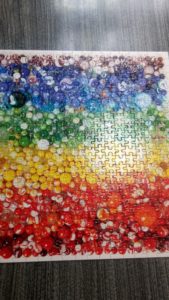
A completed puzzle of a picture of marbles arranged in a rainbow pattern – it was more difficult than it looks.

Taking a walk may not help you solve all your tough puzzles but the exercise is still good for you.

A field of dandelions in front of a mountain (Note: Objects may be closer than they appear).

So what did daisies have to do with yesterday’s post – they represented the pause I took to let all the material that I had read settle into a few take home points about real world strategies that might help protect people with a genetic predisposition to Alzheimer’s Disease or autism – vigorous exercise regularly may help; a diet with a lower than typical balance of calories from carbohydrates versus fats and protein (30% carbohydrate calories); and occasional fasting for a day or afternoon (14) may all help the body to clear out the protein deposits that seem to collect and lead to Alzheimer’s or autism changes in the brain.

Disclaimer: Opinions are my own and the information is provided for educational purposes within the guidelines of fair use. While I am a Registered Dietitian this information is not intended to provide individual health guidance. Please see a health professional for individual health care purposes. Thanks.

Genetic Screenings can give guidance about potential medication adverse reactions.

I had a more complete ancestry.com genetic screening done and an independent (for research/personal use only) analysis of the raw data showed that I have an impaired ability to process drugs including olanzapine. (Note for new readers, I had a very bad reaction to that drug, and am not alone per some patient forum feedback by others who had trouble with it causing very bad mood changes when trying to stop using it. Get the genetic screening done first would be my strongly worded advice – suicide and homocide has been associated with withdrawal from the drug and it can cause diabetes and significant weight gain while using it.)  https://www.snpedia.com/index.php/gs155

Additional reference for further discussion of the advances in the use of genetic screenings for medication risk is available in a book that is already slightly dated with the rapid advances in technology but as a starting point it is helpful for an overview on the history of technological advances in the area of medical care: The Creative Destruction of Medicine: How the Digital Revolution will Create Better Health Care, by Eric Topol, M.D., 2013. Basic Books. ISBN: 978-0465061839. (1) (“Book Review…,” and summary, by Jung A Kim, RN, PhD, PubMed_2)

One of the pioneers in personal genetic screening was Esther Dyson, a venture capitalist. She quoted a colleague regarding why she agreed to be one of the first ten participants in the Personal Genome Project:

“You would no more take a drug without knowing the relevant data from your genome than you would get a blood transfusion without knowing your blood type.” [128] (1)

The future of individualized health care will include genetic screening for everyone and what isn’t addressed in the book by cardiologist and translational research specialist Eric Topol, M.D. is the use of genetic screening for individualized nutrition guidance. In addition to discovering what medications may work better or be more dangerous for an individual genetic screening can target which types of exercise or diet plans may be more or less beneficial and which nutrients may need to be restricted or supplemented more than the average guidance.

My previous genetic screening was for fewer genes but which were chosen as most commonly a problem for children on the autism spectrum – I had 11 of the 30 and the guidance led to supplements and diet changes that have helped me feel better and have better mood stability – “Methylation Cycle Defects – in me, Genetic Screening For Research Purposes Only” – at this stage it is a legal phrase as genetic screening is not considered consistent enough for use as a diagnostic tool, but my personal health is of significant interest to me.

Chronic illnesses that I may be more prone to include inflammatory intestinal disease https://www.snpedia.com/index.php/rs2241880 and other autoimmune conditions and Type 1 diabetes. I may produce less insulin than average. https://www.snpedia.com/index.php/rs7574865

and suicidal ideation with depression and/or bipolar disorder. https://www.snpedia.com/index.php/rs10748045

I may have reduced MOAO activity which means reduced breakdown of brain neurotransmitters that affect mood. rs6323(T;T)

And reduced drug metabolism which could affect dosage of some immune suppressing and cancer treatment drugs. https://www.snpedia.com/index.php/rs1800460

A few areas may increase my risk of heart disease, especially with a high fat diet, and especially if stress-related, cortisol induced,  https://www.snpedia.com/index.php/rs6318   and I may have increased risk for aortic or brain aneurysm (weak blood vessels bursting – lovely – but not really a surprise with my severe migraine history – it always felt like something was wrong with my blood vessels in one area of my brain that MRI showed I had “tortuous” twisted shaped vessels – okay – meditating calmly about all that, thanks.)   https://www.snpedia.com/index.php/rs10757278

Heart attack/cardiac arrest is at increased risk if I also have hypertension (which I don’t – magnesium rich diets are associated with reduced risk of high blood pressure). https://www.snpedia.com/index.php/rs187238

while other genetic differences may decrease my heart disease risk; and vigorous exercise may be needed for me to be able to maintain a healthy weight. I may be able to lose weight easier on a low fat diet; and more likely to gain on a high saturated fat diet. https://www.snpedia.com/index.php/rs5082

Another is associated with increased obesity risk, there may be a disruption/decrease “loss of mitochondrial thermogenesis.” – in other words, inefficient energy production by the cellular structures that turn glucose sugar into usable energy. https://www.snpedia.com/index.php/rs1421085

It involves a protein that is an enzyme and is called more simply the FTO protein or more chemically, the – “alpha-ketoglutarate-dependent dioxygenase FTO is an enzyme that in humans is encoded by the FTO gene located on chromosome 16” – Wikipedia/FTO gene. FTO stands for Fat mass and obesity-associated protein. The protein is involved in demethylating DNA/RNA strands – which means it is involved in activating other genes. Methyl groups are an Oxygen-Hydrogen group, potentially one part of the water molecule when combined with one more Hydrogen, and when a DNA/RNA genetic strand is fully methylated in any potential bonding areas then the gene is inactive, methyl groups are a little like an off switch for the gene. So to not have the FTO enzyme I would be unable to turn some genes to the active/on phase. Clinical trials/observation of patients with the genetic difference found what was not turned off was the appetite, significantly more calories (125-280 Kcal) were eaten each day compared to control group subjects who didn’t have the difference. The difference is also associated with decreased verbal fluency, frontal lobe size and an increased risk for Alzheimer’s Disease. Wikipedia/FTO gene. What to do about it is not mentioned.

I do have genes associated with an increased childhood sensitivity to bitter flavors that may become as an adult, taste that is more accustomed to the flavor. https://www.snpedia.com/index.php/gs227

The screening does show a folate, B vitamin, difference similar to that found in a more specific genetic screening designed to reveal autism related differences that I had done with a different company a few years ago. The difference would increase my need for folate as my ability to process it may be only 10-20% of normal, and the lack of folate can increase the risk of excess build up of a chemical (homocysteine) associated with heart disease risk, especially if I was also low in B12 and B6.  https://www.snpedia.com/index.php/rs1801133

I may have increased risk for breast cancer. rs2981582(C;T)

Genetic screenings are just a possibility, not a sure thing. I have a 99% likelihood of having blue eyes – but I don’t, I have green eyes.   https://www.snpedia.com/index.php/rs12913832 

Although I may have increased risk of scoliosis – which I do have a slight case of – https://www.snpedia.com/index.php/rs11190870

There is an increased chance that I’m optimistic and handle stress well – isn’t that swell? rs53576(G,G) (No link because this is a long file and it is starting to not respond, I am using a slow internet speed.)

Normal (A2/A2) Better avoidance of errors. Normal OCD risk, normal Tardive Dyskinesia risk, lower ADHD risk. Less Alcohol dependence. Higher risk of Postoperative Nausea. Lower obesity. Bupropion is effective.”  – Bupropion is a psychiatric medication that I did find helpful for years but eventually developed some side effects and stopped using it.

The genetic screening was done by ancestry.com and the raw data from the screening was processed independently (small fee) by the promethease.com website.

It may be clear that genetic screening is a complex topic and is for general health guidance rather than diagnostic purposes although the drug sensitivity information is used by medical professionals in some areas of treatment.

A couple other positive gene differences may provide me a better than average memory and muscle fibers that are better for moving fast – sprinting.

  • Disclaimer: Opinions are my own and the information is provided for educational purposes within the guidelines of fair use. While I am a Registered Dietitian this information is not intended to provide individual health guidance. Please see a health professional for individual health care purposes.
  1. Eric Topol, M.D,, The Creative Destruction of Medicine: How the Digital Revolution will Create Better Health Care, 2013. Basic Books. ISBN: 978-0465061839.  (1) Chapter 5, Biology: Sequencing the Genome, page 117: [128]
  2. Jung A Kim, RN, PhD, Book Review: The Creative Destruction of Medicine: How the Digital Revolution will Create Better Health CareHealth Inform Res. 2013 Sep; 19(3): 229–231.  https://www.ncbi.nlm.nih.gov/pmc/articles/PMC3810531/ PubMed_2)

[128] Esther Dyson, “Full Disclosure,” Wall Street Journal, July 25, 2007, A15.

Cannabinoids and Alzheimer’s Disease

The body needs carbohydrates, proteins, fats, vitamins, trace minerals, and phospholipids and many other chemicals that can be made within the body if it is well-nourished and has average genetic and youthful abilities. That is a lot to expect from a body and a nutritionist can be a helpful expert to have on your team.

It is 420 day – a typical day in some circles to discuss or celebrate cannabinoids – so some celebratory news – cannabinoids have been shown to help breakdown the clumps of protein that lead to Alzheimer’s Disease – and the good news from my research for everyone who prefers to keep their distance from cannabis/marijuana itself is that cannabinoids are part of cell membranes and can be found in many foods in small quantities and in a few foods in larger quantities.   https://www.medicalmarijuanainc.com/dr-titus-insights-alzheimers-research-work-dr-schubert/ – According to this article $200 billion is spent on Alzheimer’s Disease care every year. That would buy a lot of pumpkin seeds.

The article also includes the number 192 – the number of pharmaceutical chemicals that have been anticipated and tested in hope of a cure or effective treatment for Alzheimer’s Disease that have ultimately not been successful. One hundred and ninety two chemicals tested, one hundred and ninety two chemicals found ineffective – cannabinoids however have been found effective at helping the body to naturally break down the tau and  beta-amyloid protein clumps that lead to brain damage and later symptoms of dementia in Alzheimer’s Disease and a few other neurological conditions including traumatic brain injuries and autism. (links re tau/amyloid in autism & Alzheimers) (links re tau/amyloid protein in traumatic brain injury)

So I personally don’t want to wait for number 193, 194, 195, 196, 197, 199 and 200 in hopes that a patent protected chemical treatment can be found to substitute for our body’s natural abilities – I would rather eat pumpkin seeds and other phospholipid rich foods today. Ibuprofen is a pharmaceutical that is no longer covered by a patent and it has been found to be beneficial in protecting against Alzheimer’s Disease (link: https://www.sciencedaily.com/releases/2018/03/180326140239.htm) and the underlying reason is likely that ibuprofen prevents the break down of cannabinoids (book excerpt)(a variety of links) – but you need cannabinoids first and some people might no longer be able to make them after a certain age or state of health or may never have been able to make them as well due to genetic differences.

So celebrate protecting your brain today by eating pumpkin seeds, cardamom spice, Rosemary, chocolate, or leafy green vegetables. – the brightly colored tiny inner part of a piece of corn that you can see when eating corn on the cob is also a good source.

Another source of a variety of beneficial phytonutrients that we tend to discard instead of eating is the white part around oranges and grapefruit – don’t worry about trimming it all away because it is good for us and mild in flavor. The tougher peel also has beneficial nutrients but it is strongly flavored and can be used in tiny amounts to add a lemony flavor to foods, either freshly grated as lemon or orange zest, or it can be purchased in Middle Eastern grocery markets as powdered dried lemon or lime (Citron vert Seche moulu or Limon seco molido, or Arabic, see example). For maximal flavor add the dried lemon or lime after cooking at the table. The flavor rich terpenes that give the lemony flavor can be effected by long cooking times. The boiling point of limonene is 348.8°F.

Disclosure: This information is being provided for educational purposes within the guidelines of Fair Use. While I am a Registered Dietitian is is not intended to provide individualized health care guidance. Please seek an individual health care professional for the purpose of individualized health care guidance. Thanks.